The "SQ3R" Method: A Timeless Approach to Reading Comprehension
Unlock Your Reading Potential: Mastering Comprehension with SQ3R
Hey there, bookworms and knowledge seekers! Ever feel like you're reading a book, but the words are just… bouncing off? Like you're slogging through a dense forest of text, and at the end, you're not quite sure what you've just encountered? We've all been there. You spend hours pouring over textbooks, articles, or even that juicy novel you've been dying to read, only to realize you've retained about as much information as a sieve holds water. Annoying, right? Especially when that information could be the key to acing an exam, landing a promotion, or simply understanding the plot of your favorite show!
Imagine this: you're preparing for a crucial presentation at work. You've got a stack of research papers taller than your cat, and the deadline is looming. You dive in, highlighting furiously, re-reading paragraphs multiple times, and feeling increasingly overwhelmed. The clock is ticking, and you're still struggling to distill the key takeaways. Sound familiar? Or picture yourself trying to keep up with the latest advancements in your field. New articles and research papers are constantly being published, and it feels like you're drowning in an ocean of information. You want to stay ahead of the curve, but the sheer volume of reading required feels insurmountable.
But what if I told you there's a proven, time-tested method that can transform you from a passive reader into an active, engaged learner? A secret weapon that can help you conquer comprehension challenges, boost your retention, and make your reading time more effective and enjoyable? It's not some magical potion or a brain-enhancing pill. It's a simple, structured approach called the SQ3R method. Intrigued? Keep reading, because we're about to unlock the secrets to this powerful reading strategy and show you how to make it your own.
The "SQ3R" Method: A Timeless Approach to Reading Comprehension
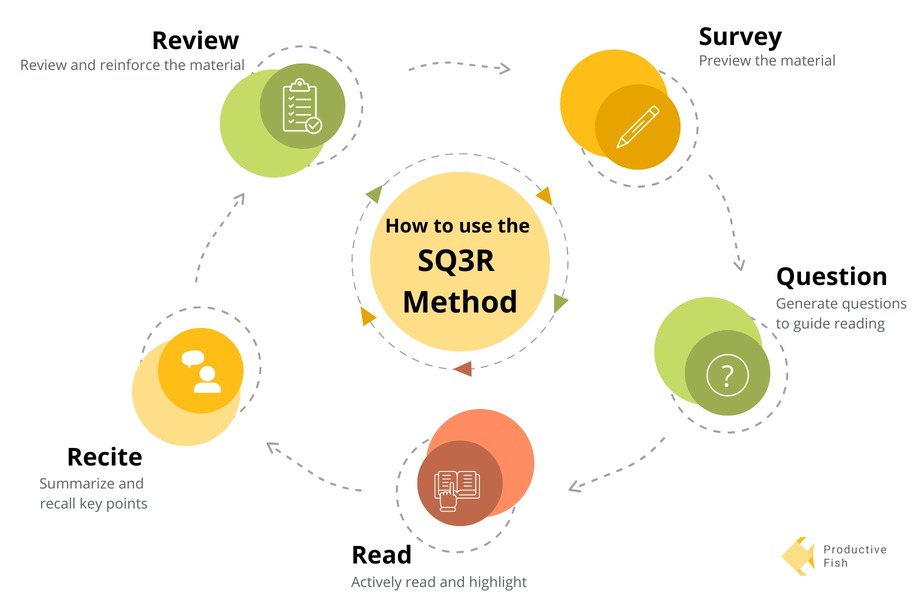
The SQ3R method isn't some newfangled invention. It's been around for decades, helping students, professionals, and lifelong learners alike to get the most out of their reading. Developed by Francis Pleasant Robinson in his 1946 book "Effective Study," SQ3R stands for Survey, Question, Read, Recite, and Review. Each step builds upon the previous one, creating a dynamic and engaging reading experience. This method isn't just about passively absorbing information; it's about actively constructing meaning and solidifying your understanding.
So, why is SQ3R still relevant today? In a world overflowing with information, the ability to read effectively and efficiently is more crucial than ever. We're bombarded with articles, reports, and social media posts vying for our attention. The SQ3R method provides a framework for navigating this information overload, allowing you to focus on what's important, extract key insights, and retain knowledge for the long term. Let's dive into each step of the SQ3R method and explore how you can apply it to your own reading habits.
Breaking Down the SQ3R Method
Let's explore the five components that make SQ3R such a powerful tool:
• Survey
Think of the "Survey" stage as reconnaissance before a battle. Before you dive headfirst into the text, take a few minutes to get the lay of the land. This involves skimming the material to get a general overview of its content and structure. Look at the title, headings, subheadings, and any visuals like charts, graphs, or images. Read the introduction and conclusion paragraphs. These elements provide a roadmap of the text, giving you a sense of the main topics, arguments, and overall purpose. Don't get bogged down in the details at this stage. The goal is simply to familiarize yourself with the material and identify the key areas of focus. For example, if you are reading a business article, pay attention to headings like "Market Analysis", "Competitive Landscape", or "Future Projections". Recognizing these cues early on helps you anticipate the content and prepare your mind for deeper engagement. This approach is particularly useful for technical documentation, academic journals, and comprehensive reports where an overview can prevent disorientation.
• Question
Now that you've surveyed the text, it's time to start asking questions. Transform the headings and subheadings into questions. For example, if a subheading is "Benefits of Cloud Computing," turn it into "What are the benefits of cloud computing?" This active questioning approach transforms you from a passive reader into an active learner. Instead of simply receiving information, you're now actively seeking answers. These questions will guide your reading and help you focus on the most relevant information. Consider the questions a treasure map leading to knowledge gold. This is where you engage your curiosity and critical thinking. This step is invaluable when dealing with opinion pieces or argumentative essays where identifying the core questions helps you assess the author's stance and supporting evidence effectively.
• Read
With your questions in mind, it's time to read the text actively. As you read, look for the answers to the questions you formulated in the previous step. Pay attention to keywords, definitions, and examples that support the main points. Don't be afraid to highlight, underline, or make notes in the margins. Engaging with the text in this way helps you to process the information more deeply and retain it more effectively. This is where you become a detective, piecing together clues to solve the knowledge puzzle. If a passage seems unclear, reread it or consult other resources for clarification. Remember, reading isn't a race. It's a journey of discovery. When tackling scientific papers or research reports, focus on understanding the methodology, results, and conclusions to answer your pre-set questions accurately.
• Recite
This is where the magic happens! After reading a section, stop and try to recall the main points in your own words. Close the book or cover the text and see if you can answer the questions you formulated earlier. This active recall process is crucial for consolidating your understanding and transferring information from short-term to long-term memory. Don't just parrot back what you read. Strive to rephrase the information in a way that makes sense to you. Use examples, analogies, or personal experiences to connect the concepts to your existing knowledge. If you struggle to recall certain points, go back and reread those sections. The "Recite" stage is like rehearsing for a performance. The more you practice, the more confident and fluent you'll become. This is particularly helpful when studying for exams or preparing to teach a subject, as it forces you to process and articulate the information effectively.
• Review
The final step in the SQ3R method is review. After you've finished reading the entire text, take some time to review your notes, highlights, and answers to your questions. This reinforces your understanding and helps you to identify any areas where you still need clarification. Review the material periodically to prevent forgetting. Schedule regular review sessions to refresh your memory and keep the information fresh in your mind. Think of the "Review" stage as polishing a gem. The more you refine it, the more it shines. This is where you solidify your understanding and ensure that the knowledge sticks. This step is crucial for long-term retention and is especially effective when combined with spaced repetition techniques, where you review the material at increasing intervals over time.
Benefits of Using the SQ3R Method
• Enhanced Comprehension: By actively engaging with the text and formulating questions, you'll gain a deeper understanding of the material.
• Improved Retention: The active recall and review processes help to transfer information from short-term to long-term memory.
• Increased Focus: The structured approach of the SQ3R method helps you to stay focused and avoid getting distracted while reading.
• Time Management: By focusing on the most relevant information and avoiding unnecessary rereading, you'll save time and increase your efficiency.
• Active Learning: The SQ3R method transforms you from a passive reader into an active learner, empowering you to take control of your learning process.
Practical Examples of SQ3R in Action
Let's look at some real-world scenarios where the SQ3R method can be applied effectively:
• Studying for Exams: Use SQ3R to tackle textbooks and study guides. Survey the chapter, formulate questions based on the headings, actively read and take notes, recite the key concepts in your own words, and review your notes regularly.
• Researching for a Project: Apply SQ3R to research articles and reports. Survey the abstract and introduction, formulate questions about the research methodology and findings, read the article carefully, recite the main points and conclusions, and review your notes to synthesize the information.
• Learning a New Skill: Use SQ3R to learn from tutorials and manuals. Survey the table of contents and chapter headings, formulate questions about the steps involved, read the instructions carefully, recite the steps in your own words, and review the material regularly to reinforce your knowledge.
• Staying Informed: Apply SQ3R to news articles and blog posts. Survey the headline and introduction, formulate questions about the main topic, read the article carefully, recite the key points and arguments, and review the article to ensure you understand the information.
Tips for Maximizing the Effectiveness of SQ3R
• Be Active: The SQ3R method is all about active engagement. Don't just passively read the text. Ask questions, take notes, and actively try to understand the material.
• Be Consistent: Stick to the SQ3R method consistently to develop good reading habits and maximize its benefits.
• Be Flexible: Adapt the SQ3R method to your own learning style and the specific type of material you're reading.
• Be Patient: The SQ3R method takes practice. Don't get discouraged if you don't see results immediately. Keep practicing, and you'll gradually improve your reading comprehension and retention.
• Use Technology: Leverage technology to enhance your SQ3R experience. Use digital highlighting tools, note-taking apps, and online resources to support your learning.
Common Mistakes to Avoid
• Skipping the Survey Step: Don't underestimate the importance of surveying the text before you start reading. This step provides a roadmap for your reading and helps you to focus on the most relevant information.
• Reading Passively: Avoid simply reading the text without actively engaging with the material. Ask questions, take notes, and try to connect the concepts to your existing knowledge.
• Neglecting the Recite Step: The recite step is crucial for consolidating your understanding and transferring information to long-term memory. Don't skip this step!
• Forgetting to Review: Reviewing the material regularly is essential for preventing forgetting and reinforcing your knowledge.
• Being Impatient: The SQ3R method takes practice. Don't get discouraged if you don't see results immediately. Keep practicing, and you'll gradually improve your reading comprehension and retention.
SQ3R and the Digital Age
While the SQ3R method was developed long before the internet era, it's arguably more relevant now than ever. In the age of information overload, the ability to effectively process and retain information is crucial. Digital tools can actually enhance the SQ3R process. For instance, you can use online mind-mapping tools to organize your thoughts during the survey and review stages. Digital note-taking apps allow you to easily highlight, annotate, and categorize information as you read. Furthermore, online flashcard platforms can be used to reinforce recall during the recite stage, leveraging spaced repetition algorithms to optimize long-term retention. In short, the SQ3R method provides a framework, and digital tools provide the scaffolding to make it even more effective in today's information-saturated environment.
SQ3R for Different Learning Styles
The beauty of SQ3R is its adaptability. It can be tailored to suit various learning styles. For visual learners, creating diagrams and mind maps during the survey and review stages can be highly beneficial. Auditory learners might find it helpful to recite the information aloud or discuss it with others. Kinesthetic learners can engage by writing summaries or creating physical models to represent the concepts. By understanding your preferred learning style and adapting the SQ3R method accordingly, you can maximize its effectiveness and make the learning process more enjoyable.
Beyond SQ3R: Complementary Techniques
While SQ3R is a powerful method in itself, it can be further enhanced by combining it with other learning techniques. Spaced repetition, as mentioned earlier, is a great way to reinforce long-term retention. The Feynman Technique, which involves explaining a concept in simple terms as if you were teaching it to someone else, can help you identify gaps in your understanding. Active recall, which involves testing yourself on the material, is another effective way to consolidate knowledge. By integrating these techniques with SQ3R, you can create a comprehensive and personalized learning system.
Frequently Asked Questions (FAQ)
• Is SQ3R suitable for all types of reading material?
Yes, the SQ3R method can be adapted to various types of reading material, including textbooks, articles, reports, and even novels. However, the level of detail and effort required may vary depending on the complexity and purpose of the reading material. For instance, you might use a more streamlined version of SQ3R for a light novel compared to a dense academic paper.
• How long does it take to master the SQ3R method?
The time it takes to master the SQ3R method varies depending on your individual learning style, reading habits, and the amount of time you dedicate to practice. However, with consistent effort and application, you can start to see noticeable improvements in your reading comprehension and retention within a few weeks.
• Can I modify the SQ3R method to suit my own needs?
Absolutely! The SQ3R method is a flexible framework that can be adapted to your own learning style and preferences. Feel free to experiment with different variations and modifications to find what works best for you. The key is to stay active, engaged, and consistent in your approach.
• Does SQ3R work for digital content?
Yes, SQ3R is highly applicable to digital content. Use digital tools for highlighting, note-taking, and mind-mapping to enhance the process. The key is to remain active and engaged, regardless of the medium.
So, there you have it – the SQ3R method, a timeless approach to reading comprehension that can transform you from a passive reader into an active, engaged learner. By following the steps of Survey, Question, Read, Recite, and Review, you can unlock your reading potential, boost your retention, and make your reading time more effective and enjoyable.
Are you ready to take control of your reading and unlock your full learning potential? Start implementing the SQ3R method in your daily reading habits. Experiment with different variations, adapt it to your own learning style, and track your progress over time. You might be surprised at how much more you can learn and retain!
Now, go forth and conquer those books! What's the first thing you plan to read using the SQ3R method?

Post a Comment for "The "SQ3R" Method: A Timeless Approach to Reading Comprehension"
Post a Comment