How to Find and Apply for College Scholarships This Year
How to Find and Apply for College Scholarships This Year
Hey friends. Let's talk about something that can literally change your life — or at least save you from drowning in student loan debt. Scholarships. Yeah, we all know they exist, but finding and actually landing one? That's a whole different game. So grab a coffee, settle in, and let's walk through this together.
Why Scholarships Matter More Than Ever
Here's the deal. College tuition keeps climbing year after year, and salaries aren't keeping pace. We're looking at average annual costs pushing past $10,000 for in-state public universities and skyrocketing past $40,000 for private institutions. That's before room, board, books, and all those "small fees" that somehow add up to a fortune.
Now here's what nobody tells you straight up — scholarships aren't just for the kids with 4.0 GPAs and Olympic medals. There's money out there for athletes, artists, community volunteers, first-generation students, kids from specific zip codes, students studying niche subjects, and honestly, people who just showed up and applied. The bottleneck isn't availability. It's awareness and effort.
The Scholarship Landscape: What You're Actually Working With
Types of Scholarships You Should Know About
Before you start hunting, you need to understand what's out there. Not all scholarships are created equal, and knowing the categories helps you target your search.
Merit-Based Scholarships
These are the classic ones. High grades, solid test scores, strong extracurriculars. Colleges hand these out to attract top talent. If you've been crushing it academically, this is your lane.
Need-Based Scholarships
These look at your financial situation. Your family income, assets, and circumstances determine eligibility. The FAFSA is usually the gateway here. If money is tight, don't skip this category — it's where a huge chunk of funding lives.
Identity-Based Scholarships
These target specific demographics — women in STEM, minority students, first-generation college attendees, military families, LGBTQ+ students, and more. Organizations want to diversify their fields, and they'll pay you to join them.
Talent and Activity-Based Scholarships
Athletes, musicians, debaters, filmmakers, coders — if you've got a skill that stands out, there's likely a scholarship riding behind it. This is where a lot of students sleep on opportunities because they don't think their hobby counts as talent.It does.
Employer and Community Scholarships
Your parent's employer, local Rotary clubs, small businesses, churches, and community foundations often have scholarship programs that get zero applicants. Seriously. Low competition, real money. Check everywhere you already have connections.
Where to Actually Find Scholarships
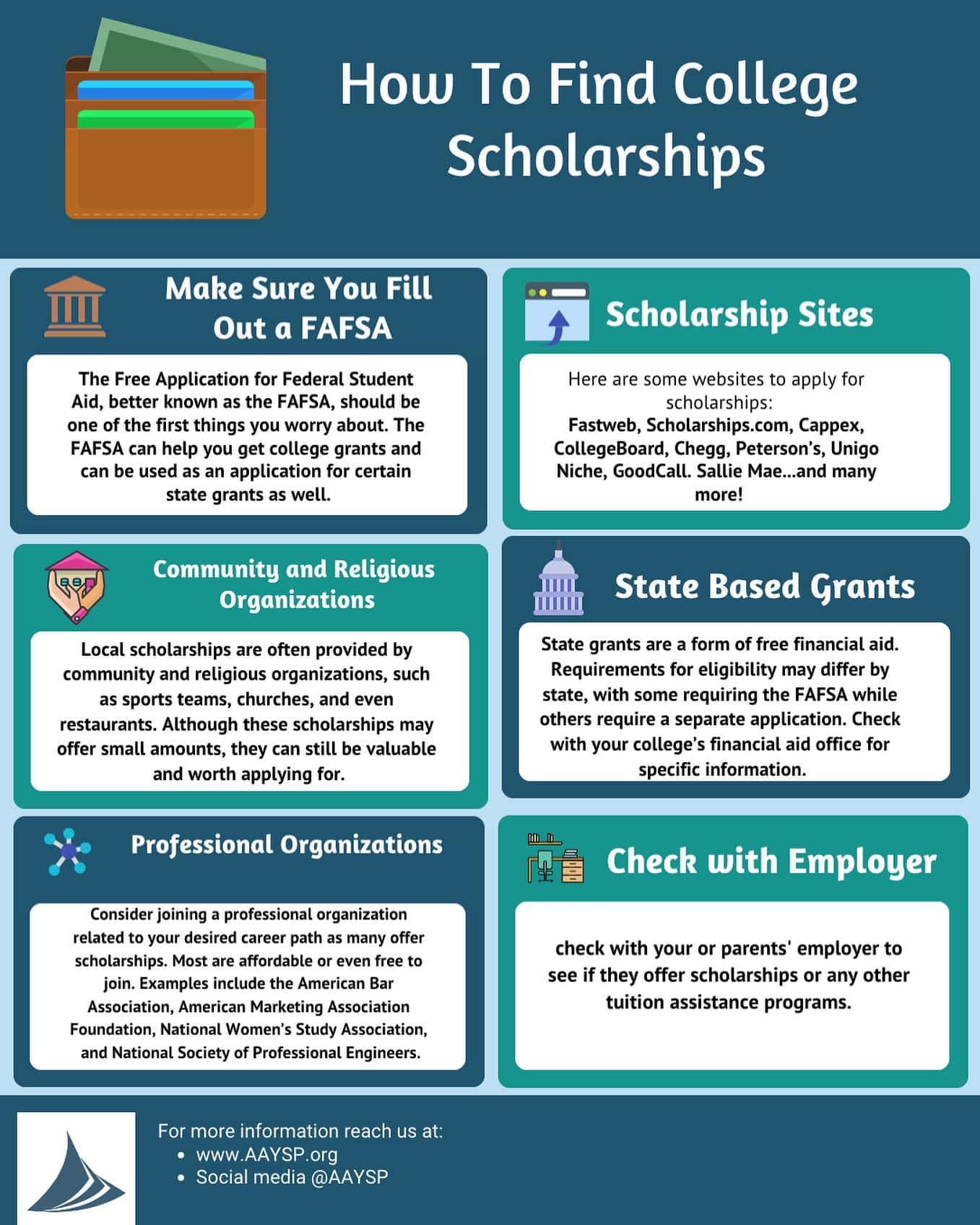
Alright, now we're getting into the real work. Knowing what exists is one thing. Finding it is another. Here's where you should be looking:
Online Scholarship Databases
Start with the big ones. Fastweb, Scholarships.com, Cappex, and Chegg Scholarships. These platforms let you build a profile and match you with opportunities based on your background, grades, interests, and goals. Set up alerts and check them weekly. New scholarships pop up constantly.
College Financial Aid Offices
Don't sleep on the institutions themselves. Once you're admitted, your school's financial aid office has access to institutional scholarships, state grants, and exclusive funding pools that you won't find anywhere else. Walk in, talk to a real human, and ask what's available.
Local and Community Organizations
This is the goldmine nobody mines enough. Local businesses, civic organizations, churches, parent-teacher associations, and city foundations often run scholarship programs with tiny applicant pools. A scholarship with 15 applicants beats one with 15,000 every single time.
Employer Programs
If you're working — even part-time — check if your employer offers tuition assistance or scholarship programs. Major companies like Starbucks, Amazon, Target, and Walmart have education benefits. Don't assume your small local employer doesn't either. Just ask.
Government and State Programs
Federal and state governments offer grants and scholarships that many students overlook. The Pell Grant, state-specific tuition waivers, and military benefits like the GI Bill are all part of the ecosystem. Check your state's education department website for programs specific to your area.
How to Apply Like a Pro
Finding scholarships is half the battle. Applying well is the other half. Here's what we've learned from watching thousands of students navigate this process.
Start Early and Stay Organized
Scholarship deadlines are ruthless. They don't care about your excuses. Create a spreadsheet — yes, an actual spreadsheet — with columns for scholarship name, deadline, requirements, status, and notes. Update it weekly. Treat it like a job because, functionally, it is.
Tailor Every Application
Here's a mistake we see constantly: students reuse the same essay for every scholarship. It shows. Read the prompt carefully. Understand what the organization values and mirror that language back to them. A community-service-focused scholarship wants to hear about your service, not your debate trophy. Match the energy.
Write Essays That Hit Different
Your essay is your handshake, your voice, your story. Start with something that grabs attention immediately — not "My name is ___ and I want to go to college." Tell a specific story. Show vulnerability. Connect your personal experience to the scholarship's mission. Be authentic because committees can smell generic from a mile away.
Get Recommendations Done Right
Ask for recommendations early — like, weeks early. Give your recommenders context about the scholarship and what the organization values. Provide them with your resume, your personal statement draft, and a bullet-point list of key moments you want highlighted. Make their job easy, and they'll write you a stronger letter.
Polish Your Application Package
Every detail matters. Check for typos. Verify that your transcripts are official and current. Make sure your resume is formatted cleanly and highlights relevant achievements. Submit everything before the deadline — not at the deadline, before. Technical glitches happen, and you don't want to be the person explaining why you submitted two minutes late.
Apply Broadly and Apply Often
Here's the math that should push you: if you apply to 20 scholarships with an average value of $500, that's $10,000. Apply to 50? You're looking at serious money. Don't be picky. Apply to everything you're even slightly eligible for. The worst they can say is no.
Common Mistakes That Kill Your Chances
Let's talk about what not to do, because the mistakes are often more revealing than the tips.
Waiting until senior year. Scholarships exist for juniors, sophomores, and even middle schoolers. The earlier you start, the more options you have. Some programs have age-specific tiers that you'll miss entirely if you wait.
Ignoring the fine print. Every scholarship has terms and conditions. Some require maintaining a certain GPA. Others have service commitments or geographic restrictions. Read everything. If you accept and then can't meet the requirements, you might have to pay it back.
Applying for scholarships you don't genuinely qualify for. There's a difference between stretching your eligibility and fabricating credentials. Be honest. Committees check, and getting caught means a blacklist, not just a rejection.
Skipping smaller scholarships. That $200 scholarship from a local dental hygienist association? It's $200 you don't have to borrow with interest. Stack enough of those and you've got real money.
Key Points to Remember
- Start now. Not next week. Today. Every day you wait is money left on the table.
- Cast a wide net. Apply to everything you're eligible for. Volume matters.
- Local beats national. Smaller pools mean better odds.
- Your story matters. Committees fund humans, not transcripts.
- Organization is non-negotiable. Track deadlines, requirements, and submissions like your financial future depends on it — because it does.
- FAFSA is the foundation. Even if you think you won't qualify, fill it out. Many scholarships use FAFSA data to determine eligibility.
- Follow up. If you're waitlisted or haven't heard back, a polite follow-up email shows initiative and keeps you on their radar.
- Keep applying through college. Scholarships aren't just for incoming freshmen. Many renew annually or have specific awards for current students.
Frequently Asked Questions
Q: How many scholarships should I apply for to have a realistic chance?
A: There's no magic number, but here's the honest truth — the more, the better. We'd say aim for at least 15-20 applications per cycle. Some students apply to 100 or more. The key isn't quantity alone; it's applying strategically to scholarships where you genuinely fit the criteria. Quality over quantity matters, but don't mistake being selective for being lazy. Apply broadly, tailor each one, and you'll dramatically improve your odds.
Q: Can I win a scholarship if my grades aren't perfect?
A> Absolutely. Grades matter for merit scholarships, but they're only one category. Need-based scholarships, talent-based awards, community-specific funding, and identity-based programs don't always hinge on your GPA. Many organizations look at leadership, community involvement, personal challenges, work ethic, and future goals. If your grades aren't stellar, double down on the categories where you shine brightest.
Q: When should I start applying for scholarships?
A: The earlier the better, and we mean way earlier than senior year. Some scholarships are available as early as ninth grade. Start researching during your sophomore year, build your profile, and begin applying during junior year. By senior year, you should be in full application mode. But even if you're already in college — or planning to go — it's not too late. Many scholarships are open to current students.
Q: Are online scholarships legitimate, or am I going to get scammed?
A: Great question, and healthy skepticism is warranted. The golden rule: never pay to apply for a scholarship. Legitimate scholarships don't charge application fees, processing fees, or "winning fees." Stick to well-known databases like Fastweb, Scholarships.com, and the official financial aid pages of colleges and universities. If something feels sketchy — like an email asking for your Social Security number or banking details upfront — trust your gut and walk away.
Conclusion
Here's the bottom line, friends. Scholarships are real money sitting on the table, and nobody's coming to hand it to you. You have to go get it. The process isn't glamorous — it's spreadsheets, essays, and waiting. But every dollar you earn through a scholarship is a dollar you don't borrow, and that's a dollar that doesn't accrue interest for decades.
We've seen students go from drowning in financial anxiety to graduating nearly debt-free because they decided to take this seriously. You don't need to be perfect. You don't need to be the most talented or the smartest or the most connected. You just need to be consistent, organized, and willing to put in the work.
So start today. Build your list. Write your first essay. Ask a teacher for a recommendation. Fill out that FAFSA. The scholarship you need is out there — probably several of them — and they're waiting for someone exactly like you to apply.
Don't be that person who knew about the opportunity but didn't take action. Be the one who did. Your future self will thank you.

Post a Comment for "How to Find and Apply for College Scholarships This Year"
Post a Comment