Why Music Education Matters for Cognitive Development
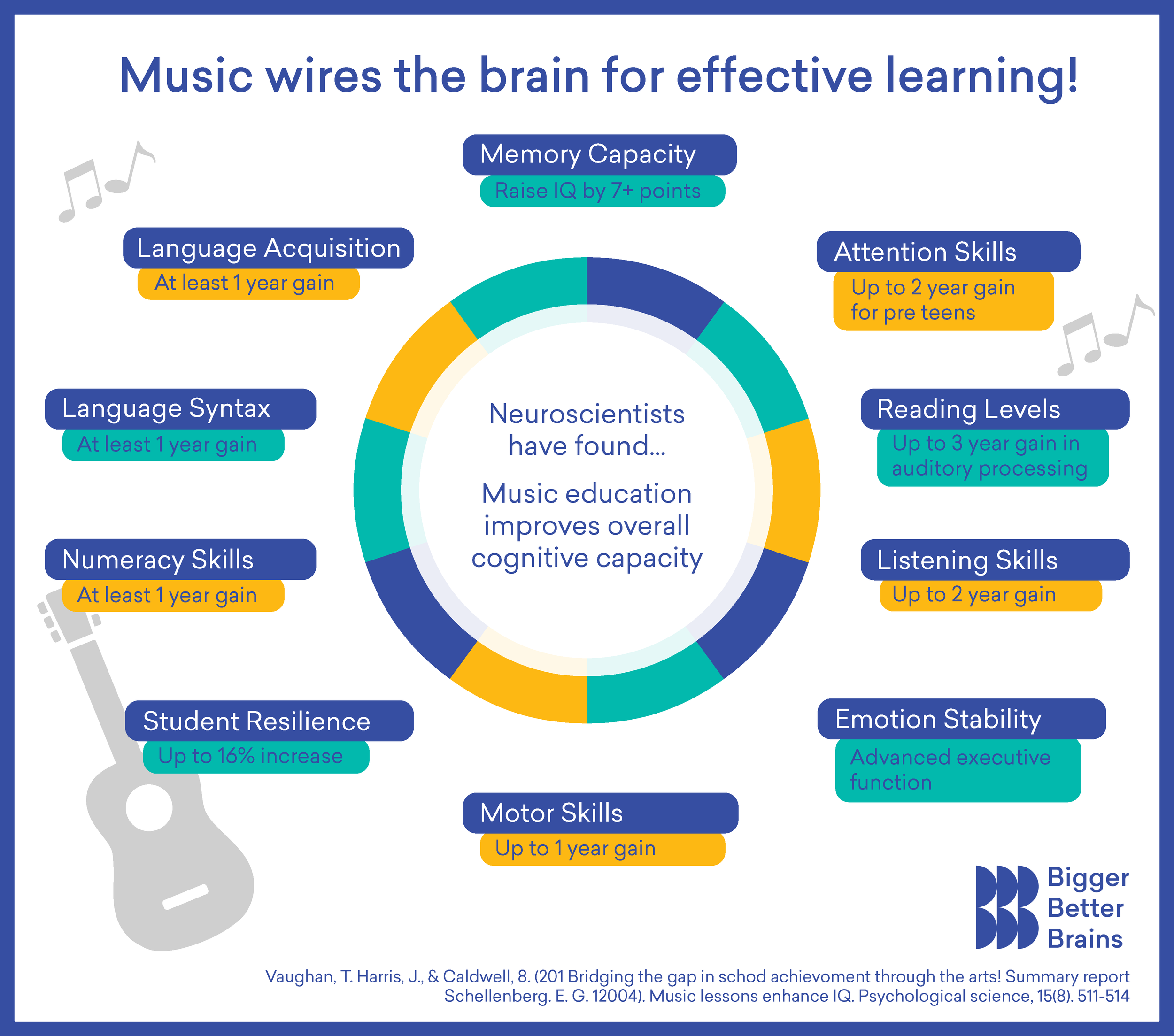
Why Music Education Matters for Cognitive Development
Hey friends, let's talk about something that gets thrown around a lot at dinner parties, in school board meetings, and in those slightly panicked conversations parents have when they're deciding where to spend limited time and money. You've heard the claim: music makes you smarter. Maybe you've seen the headline. Maybe you've rolled your eyes at it. Maybe you've quietly wondered whether it's actually true or just the kind of thing people say because it sounds nice.
Here's the honest answer, and it's more interesting than the slogan: music education doesn't work like a magic pill, but it does something arguably better. It puts the brain through a specific, demanding, multi-system workout that almost nothing else replicates. And the cognitive benefits that come out of that workout are real, measurable, and — this is the part people miss — deeply tied to how music is taught, not just whether it's present.
So let's dig in. We're going to look at what's actually happening in the brain, what the research genuinely supports, where the hype has overshot, and what you can do with all of this whether you're a parent, a teacher, or an adult who's been meaning to pick up that guitar for eleven years.
First, Let's Clear Up the Myth
You've probably heard of the "Mozart effect." The story goes that playing classical music to your kids makes them smarter. It came out of a 1993 study where college students who listened to a Mozart sonata performed slightly better on a spatial reasoning task for about ten to fifteen minutes. That's it. Ten to fifteen minutes. And the effect was small.
Then the media got hold of it, and suddenly we had a generation of parents buying Baby Einstein DVDs and expecting a tiny genius by age three. When researchers tried to replicate the effect, it mostly evaporated. The truth is that passive listening does very little for long-term cognitive development. Enjoying music is wonderful. It's not a cognitive training program.
What does show real, durable effects is active music-making — singing, clapping, counting rhythms, learning an instrument, reading notation, playing in an ensemble. The difference between listening and doing is the difference between watching someone lift weights and lifting them yourself. Your brain needs to do the work.
What's Actually Happening in Your Brain
When you learn to play an instrument, you're not just training your ears. You're running a genuinely absurd number of processes at once, and that's precisely why it's so cognitively valuable.
Neuroplasticity: Your Brain Rewires Itself
Learning music is one of the most powerful natural drivers of neuroplasticity we know about — the brain's ability to physically reorganize itself in response to experience. In musicians, researchers have consistently found structural differences: a thicker corpus callosum (the bundle of fibers connecting the two hemispheres), more gray matter in motor and auditory regions, and enhanced white matter connectivity in areas that link hearing, movement, and planning.
Think about what playing an instrument demands. You see a symbol on a page. You translate it into a pitch and a duration. You send a motor command to your fingers with millisecond precision. You hear the result, compare it to what you intended, and adjust. You do this while tracking a beat, keeping time with others, and predicting what comes next. That loop — see, decode, move, hear, evaluate, correct — runs thousands of times in a single practice session. No wonder the brain changes.
The Cross-Hemisphere Connection
Here's one that delights me. Because music requires both hemispheres to cooperate — the left handling rhythm, sequence, and language-like structure, the right handling pitch contour and timbre — musicians develop unusually strong communication between the two sides. The corpus callosum literally gets thicker. This matters because cross-hemisphere integration is associated with better performance on tasks that require coordinating multiple kinds of information at once. It's like upgrading the highway between two busy cities.
The Sound-to-Symbol Loop
Reading music is a genuinely strange cognitive feat. You're mapping a visual symbol onto a physical action onto an auditory outcome, and eventually you can do it fast enough that it feels automatic. That's a cross-modal mapping skill, and it generalizes. Kids who learn to read music are, in a very literal sense, practicing the same kind of symbol-to-sound translation that reading written language requires.
The Cognitive Skills Music Quietly Trains
Let's get specific, because "music is good for the brain" is too vague to be useful.
Working Memory: More Balls in the Air
Working memory is your mental scratchpad — the limited space where you hold information while you manipulate it. Playing music is a working memory assault course. You're holding the next few notes in mind, tracking the beat, remembering the key signature, monitoring your posture, and listening to your own sound. Musicians consistently score higher on working memory tasks, and working memory is one of the strongest predictors of academic achievement across the board.
Executive Function: The Art of Stopping Yourself
Executive function is the suite of mental skills that let you plan, focus, switch tasks, and — crucially — inhibit impulses. Music training hones all of these. Playing in an ensemble requires you to wait your turn, listen to others, and suppress the urge to speed up when you're excited. Practicing a difficult passage requires you to stop, isolate the problem, and try again instead of just barreling through. That's impulse control dressed up as music lessons, and it transfers.
Language and Reading
This is one of the most robust findings in the field. Music and language share neural machinery — both involve pitch, timing, timbre, and the segmentation of a continuous stream of sound into meaningful chunks. Children who receive music training show improvements in phonological awareness, which is the ability to hear and manipulate the individual sounds inside words. And phonological awareness is one of the strongest early predictors of reading success.
Rhythm matters here too. Several studies have found that children's ability to keep a steady beat predicts their reading and grammar skills. Beat-keeping is essentially a timing skill, and reading requires precise timing — matching letters to sounds, tracking syllables, parsing sentences. If your internal clock is sloppy, reading gets harder.
Math, Pattern, and Spatial Reasoning
Music is full of mathematical structure: fractions (a half note, a quarter note), ratios (intervals), patterns, symmetry, and hierarchical organization. That doesn't mean music lessons replace math class, but it does mean musicians get years of embodied practice with proportional reasoning and pattern recognition. Some research links music training to improved spatial-temporal reasoning, though the effect sizes are modest and the mechanisms are still being worked out. Be skeptical of anyone promising a math-genius shortcut.
Attention and Timing
Musicians show enhanced auditory attention — the ability to pick out a specific sound in a noisy environment, which is exactly what you do at a loud party or in a crowded classroom. They also show more precise neural encoding of sound, meaning their brains track the fine details of an acoustic signal more accurately. That's not just a music skill. It's a listening skill, and listening underpins almost everything else in a classroom.
Key Points: The Cheat Sheet
If you want to walk away with the essentials, here they are.
- Active beats passive. Listening to music is lovely, but making music is what drives cognitive change. Singing, clapping, and playing all count.
- Music trains working memory by forcing you to hold, sequence, and manipulate information in real time.
- It builds executive function — planning, focus, task-switching, and impulse control — through the discipline of practice and ensemble playing.
- It strengthens language and reading skills via shared neural circuits for pitch, rhythm, and phonological awareness.
- It thickens cross-hemisphere connections, improving the brain's ability to integrate different types of information.
- It sharpens auditory attention, making it easier to focus on relevant sound in a noisy world.
- It supports math and spatial reasoning through embodied experience with pattern, proportion, and structure — though the effects are real, not magical.
- The benefits are dose-dependent. A few months of casual lessons won't rewire anything permanently. Years of consistent engagement will.
- Early starts help, but it's never too late. Adult beginners show measurable cognitive gains too. Neuroplasticity doesn't clock out at eighteen.
- Teaching quality matters enormously. A program that emphasizes active engagement, rhythm work, and ensemble play will outperform one where kids mostly sit and listen.
So What Should We Actually Do With This?
For parents
Don't chase the genius fantasy. Chase consistency and joy. Ten minutes of singing and clapping rhythms with your kid a few times a week is genuinely valuable, and it costs nothing. If you're choosing a program, look for one that gets kids making sound quickly — recorders, ukuleles, drums, choir — rather than one that front-loads theory before anyone touches an instrument. And please, don't turn practice into a battlefield. The cognitive benefits evaporate if the kid hates it and quits at nine.
For teachers
Use rhythm as a literacy tool. Clapping syllables, marching to the beat of a sentence, chanting multiplication tables — these are cheap, effective, and backed by real evidence. You don't need a music degree to bring timing into your classroom. You need a steady beat and thirty seconds of courage.
For adult learners
Start. Seriously, start. The research on adult music learners is encouraging: beginners show improvements in executive function, working memory, and auditory processing after a few months of regular practice. Pick something you actually like. Learn three chords. Play badly. The point isn't performance. The point is the loop — see, decode, move, hear, evaluate, correct — running in your brain again.
Questions and Answers
Does my child need to be talented to get the cognitive benefits?
No, and this is one of the most important things to understand. The cognitive benefits come from the process of learning, not from achieving a high level of performance. A kid who struggles through a simple melody is doing exactly the same kind of neural work as a kid who breezes through it — arguably more, because more effort means more adaptation. Talent affects how fast you progress, not whether your brain benefits. The students who gain the most are often the ones for whom it's genuinely hard.
Is it too late to start as an adult?
Absolutely not. The idea that your brain is "done" after childhood is outdated and wrong. Adult brains remain plastic throughout life. What changes is the pace and the starting point, not the possibility. Adults actually have some advantages — better metacognition, more patience for deliberate practice, and the ability to choose music they genuinely care about. Studies of older adults learning instruments show improvements in executive function, memory, and processing speed. Start with fifteen minutes a day. That's enough.
Does listening to music count, or do you have to play?
Listening is wonderful for mood, emotional regulation, and stress reduction, and those things matter for cognition indirectly. But if you're specifically after cognitive development, you need to be doing something — singing, clapping, tapping a rhythm, playing an instrument, even humming along with intention. The active ingredient is the sensorimotor loop: perceiving sound, producing sound, and correcting in real time. Passive listening doesn't engage that loop. It's the difference between reading about swimming and getting in the pool.
How much music education do you actually need to see results?
This is where honesty matters. The studies showing the strongest, most durable cognitive effects tend to involve years of consistent, structured training — not a six-week enrichment program. Short interventions produce small, short-lived gains. That said, "years of consistent training" doesn't mean two hours a day. It means regular, sustained engagement over time: a weekly lesson plus a few short practice sessions, kept up for a couple of years. The key variables are consistency and active participation, not intensity. Small and steady genuinely wins here.
Wrapping It Up
Friends, here's where I've landed after digging through all of this. Music education isn't a cognitive steroid, and anyone selling it that way is doing the field a disservice. But it is something rarer: a single activity that simultaneously trains memory, attention, motor control, language processing, emotional regulation, and social coordination, all wrapped in something people genuinely enjoy.
That combination is hard to find. You can train working memory with computer games, but those games don't teach you to listen. You can build discipline through sports, but sports don't wire your auditory cortex to your motor system with millisecond precision. You can learn patience anywhere, but few things teach patience while also teaching you to hear the difference between almost right and right.
So whether you're signing a seven-year-old up for violin, clapping rhythms with a toddler, or finally pulling that dusty guitar out of the closet — know that you're not chasing a myth. You're giving your brain a workout that very few other things provide. And honestly? The fact that it's beautiful is a bonus we should stop treating as a footnote.
Go make some noise, friends. Your neurons will thank you.

Post a Comment for "Why Music Education Matters for Cognitive Development"
Post a Comment